Announcement

Collapse

Advertising Inquiries

See more
See less

Good article on Jupiter's moons

Collapse
X
 
  • Filter
  • Time
  • Show
Clear All
new posts

  • Good article on Jupiter's moons


    Nice article on how each Galilean moon is different and unique....

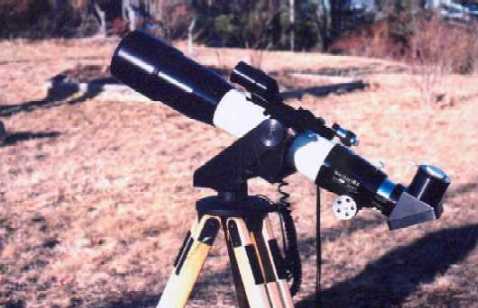
    I can see the Galilean moons easily with even a small telescope like my 2.5 inch Televue - very nice....

    The Greatest Mysteries of Jupiter's Moons | The Greatest Mysteries of the Cosmos and Universe | Europa, Io Ganymede, Callisto & Ganymede | LiveScience
  • #2
    i have to get a telescope, never had one, even as a kid.

    Comment


    • #3
      I'll give you some suggestions on what to get.

      Here are the two telescopes I have:

      The first one is a TeleVue 85, a small telescope that is portable and I can carry with me. It is carry-on size and I can take it with me anytime I go to a place that has dark skies. It is US made and is probably one of the best refractor telescopes you can buy without breaking the bank big time.

      Tele Vue Optics: Tele Vue-85


      The 2nd is a big scope. It is a 11 inch Celestron CPC-1100. It is about the biggest scope I can carry by myself (imagine picking up a large keg by wrapping your arms around it).

      CPC 1100 GPS (XLT) Computerized Telescope (item #11075-XLT) / CPC Series Computerized Telescopes / Telescopes / Products / Celestron.com


      Lots of good telescopes, lots of choices.

      Comment


      • #4
        Here's is what Jupiter and the Galilean moons look like in one of my scopes - the photo is not mine but it looks pretty much like this from my scope.

        Comment


        • #5
          i dont want any massive one.

          what is the price on the first one?

          Comment


          • #6
            I'll look some models up and post later today.

            Comment


            • #7
              I want the cheapest one I can get while still being a quality telescope. Know what I mean?

              Comment


              • #8
                Yep. I think I know just what you should get.

                A Dobsonian. It gives the biggest bang for the buck by far, super easy to use and low maintenance. The disadvantage is that it is not very portable. I'll put together some choices for you later this evening.

                Comment


                • #9
                  If I can't see the palnets and the moons like the first picture I'm not buying it. :D

                  Comment


                  • #10
                    Palnets!!! Lol

                    Comment


                    • #11
                      There is ..... They are building one called the James Webb Telescope and Congress is not giving money for it because they'd rather use it to blow shit up in the Middle East, so if you can pitch in and buy it off NASA's hands, that would be awesome. I thin it is only a couple of billion $s. :D

                      Comment


                      • #12
                        Bouncer, here are my suggestions, bro.

                        First thing: you DO NOT want to buy a mall telescope for 50 bucks. It is worse than garbage. In fact, you are better off with a pair of binoculars.

                        Second, if you are starting off, it is better to buy locally. You can do mail order when you know exactly what you want and you know how to set up a scope, etc. but for starters, I recommend going to a B&M store.

                        Here is a good one in your neck of the woods:

                        Skies Unlimited
                        Suburbia Shopping Center, 52 Glocker Way
                        Pottstown, PA 19465
                        (888) 947-2673
                        Telescopes | Telescope Accessories | SkiesUnlimited.net

                        In telescopes, there is a saying: aperture is king. Aperture is basically the size of the telescope: not length but diameter. It dictates how much light can be collected by the scope - obviously, the bigger the diameter, the more light it can collect and the fainter the objects that it can detect. And if you want to see a star cluster or nebula, those objects are pretty dim. When you talk about the size of a telescope, say 80mm or 11 inches, you are referring to the aperture or diameter.

                        If you want to really get some quality, you have basically two paths:

                        1. Get a refracting telescope.

                        Pros: They are very compact and require zero maintenance and the image quality can be exceptional. Cons: They are relatively expensive for the size (aperture) because refracting telescopes are made with lenses and good lenses that don't have chromatic aberration (false color) are difficult to make and assemble. Also, you need to buy a mount for it as well.

                        2. Get a Dobsonian reflector.

                        Pros: Dobsonians are very easy to set up and give you the biggest bang for the buck. You can get a substantially bigger scope for the same price as a refractor because Dobs are made with mirrors which are a lot cheaper and easier to make than lenses. In fact, you can get a semi-auto Dobsonian for the same price as a refractor which will allow you to punch in the name of an object and allow the telescope to automatically point to it, which may be useful for starting off. Also, they have a mount built in, so you don' t to spend extra for the mount. Cons: They require some periodic maintenance and they are not very portable, i.e. you can't carry it with you on a plane.

                        OK, now to the recommendations:

                        The best affordable refractor that I can think of is the Stellarvue SV80ED-1. Skies Unlimited has it and you can go check it out. It sells for $599 and you need to buy a mount and some eyepieces to go with it, so the total will approach $1000 or so. It is an American made scope and I can't believe how inexpensive it is for the quality - in fact, if you go refractor, there's probably not a better deal out there. Here is a link:

                        Stellarvue SV80ED


                        If you go Dobsonian, a good one to pick is the Orion Skyquest Intelliscopes. I use to have a 6" version of this scope a few years ago. It is excellent and very powerful for the money. Consider the 8" version XT8i for $549 or the XT10i (preferred if you are willing to spend the extra $200) for $729. Link is at:

                        Orion SkyQuest Intelliscope Dobsonian Telescopes | SkiesUnlimited.net

                        The reason I suggest the local purchase is because if you go the refractor route, you will need to get a tripod mount and if you get the Dob, you will need some instructions on how to collimate it (align the optics) periodically.

                        Also, you will need some accessories. A red dot finder is really useful to help locate objects easily, and depending on which eyepieces come with the scope, you might want to add a couple more - higher power to look at planets and lower power to look at deep sky objects like galaxies and nebulae.

                        Best thing you can do is to go to the store and talk to the guys there. Astronomy is such an small hobby and so much of sales, etc. is by word of mouth that usually, most dealers are straight shooters as long as they are only doing astronomy stuff - they will go out of business if they are out to screw customers. Also, many stores (depending on location) open late in the afternoon and stay open late in the evening, so you can actually do some viewing there before you make your decision.

                        That said, my recommendation would be for you to get the Dobsonian. Yes, you will need to collimate it periodically but that's pretty easy to do once you know how to do it and you'll get a huge scope that can see pretty much anything you want, especially since you live near the city and with light polluted skies, you'll need all the light-gathering power available.

                        PM me if you need more info.

                        Comment


                        • #13
                          Wow bro, thanks for typing that all up but $600.00 is way more then I am willing to spend. I would enjoy seeing all the things the universe has to offer but you have to remember I live 10 minutes from Philly. My night sky is more yellow then black. If I lived in am area that didn't have so much light pollution I might be willing to spend more.

                          Comment


                          • #14
                            Just go here, bro.

                            The Franklin Institute - Joel N. Bloom Observatory

                            The Franklin Institute's Joel N. Bloom Observatory is open for public observing of the night sky on the 2nd Thursday of every month. On these special nights, The Franklin Institute invites the public to view celestial objects in the sky, like stars, planets, and if conditions are right, a galaxy or two, from five different telescopes.

                            Night Skies takes place from 6pm to 9pm (August - May) and 7pm to 10pm (June - July) and includes a Fels Planetarium show and a lecture or presentation (appropriate for all ages) on an astronomical or space science topic. The Observatory is staffed with knowledgeable observers and free star maps are provided.

                            Admission is $5, Members are FREE!

                            The Franklin Institute
                            222 North 20th Street
                            Philadelphia, PA 19103
                            215.448.1200


                            The Franklin Institute - Special Events - Night Skies in the Observatory

                            Comment


                            • #15
                              Yea I been there as a kid. Gotta go back!

                              Comment

                              Working...
                              X